Every Student Deserves a Workaround: Meet Piano Teacher Camille Hatton
Jan 12, 2026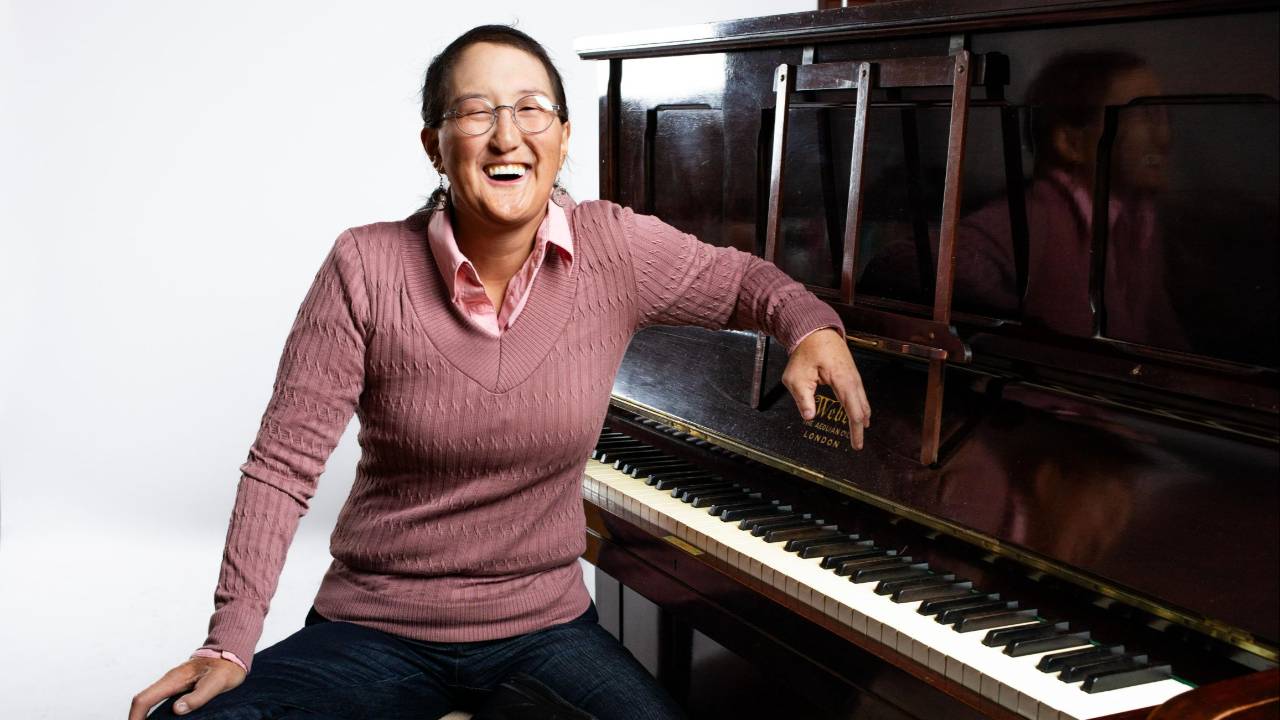
Music lessons are weirdly ubiquitous. Millions of kids take them. Parents sign up, pay tuition, drive to lessons or log onto Zoom. It can start to feel routine, unremarkable.
But Camille Hatton wants parents to pause and recognize what's actually happening: their child has a personal coach who tailors every single session to where they are, what excites them, what challenges them. "It is a really uniquely special thing to have a one-on-one coach in real time give you feedback and information purely for you to get better at this skill," she says. "It's kind of mind-blowing."
For almost any other pursuit (sports, art, academics), that level of personalized attention would be a luxury most families couldn't afford. "And yet here it is," Camille says. She finds the responsibility sacred, a privilege she doesn't take lightly.
Camille, who holds a Master of Music in Conducting, teaches online piano lessons, voice, and drums at Maestro Music from her home in Cape Town, South Africa, to students across the world. Her approach to lessons builds off of the experiences she’s had with music, both in childhood and throughout her career as a professional musician.
Camille reflects on why she loves being a music teacher.
The "Always a Workaround" Philosophy
Camille was four years old when she decided she wanted to play piano, inspired by watching her older brother take lessons. But her first piano teacher hesitated to take her on. Camille was born with a hand variance that made the teacher nervous about whether piano lessons would even be possible.
The teacher kept delaying. "When you're five, let's talk about it then," she'd say. On her fifth birthday, Camille insisted she was ready. The teacher finally agreed, though Camille now reflects on the complicated motivations behind that decision.
"She had kind of a savior complex," Camille says, choosing her words carefully. The teacher invested significant time and creativity to make piano accessible, and Camille is grateful for that. Without that teacher's willingness to adapt, she might have been turned away entirely. But the framing was uncomfortable, treating Camille's physical difference as something noble to work around rather than simply part of who she was.
That experience taught Camille two things: what creative adaptation could look like, and what motivation shouldn't drive it. She brings the creativity to her own teaching. She leaves the savior complex behind.
"Any time we value the individuality of the learner in front of us, we are all the better for it."
When Standard Repertoire Doesn't Fit
Years later, as a music major working toward her performance degree, Camille was presented with a concrete challenge. Because of her hands, she couldn't reach an octave on the piano. Standard repertoire that most pianists build their careers on (Beethoven sonatas, Mozart concertos, much of the traditional canon) was physically out of reach. But that just meant she had to shake things up.
"My physical variance is for me, it's a huge plus," she says. "What that meant was that in order for me to graduate and have performed a performance recital, it meant that I had to have access to really creative solutions for the music."
She dove into composers whose work didn't require stretching for octaves. Bartók became a favorite. She explored Debussy duets, where she could focus on flourishes and intricate textures rather than broad reaches. She discovered contemporary experimental music that combined percussive piano techniques with lyrical elements. One of her favorite pieces to perform is Emma Lou Diemer's Toccata for Piano, where she reaches inside the instrument to stop strings and pull out harmonics, playing with sound in ways that are quite literally outside the box (or…keyboard).
The constraint helped her discover repertoire most people never hear. It pushed her toward creative, unconventional approaches to the instrument, and it taught her a fundamental lesson about teaching.
"Because I had to find a workaround, I was able to access music that is really unique, that people don't hear on a regular basis," she explains. "And that particular thinking, that particular way of realizing there's always a workaround is something that I also try to pass forward to my students."
Camille performing Toccata for Piano by Emma Lou Diemer, one of her favorite pieces that showcases creative approaches to the instrument. Video courtesy of Unitarian Universalist Church of the Monterey Peninsula.
Discovering Her “Why”: Music as Connection
For many years, Camille viewed piano as just another activity, like soccer or art class. Even as she progressed through high school and college, something was missing.
"I have to admit, I actually fell into this," she says. "It wasn't really a draw to the music or the sound. It was just another activity that I was doing."
That changed after she graduated and started conducting community choirs. Suddenly, music wasn't just about individual achievement or technical mastery.
Want to help your child discover their musical "why"?
Book a free trial lesson and see what clicks.
The Power of Communal Music
Standing in front of a choir, Camille experienced something she'd never fully felt as a solo performer. When people sing together, their bodies synchronize. "It's a uniquely human thing to do, right?" she says. "To have our rhythms all line up, our heartbeats all line up, our breath all line up."
That experience moved music from an individual to a collective pursuit. "There is something really powerful in knowing that complete strangers from every ideological stance can come together and intentionally put all of that aside and just be in communal unity with each other, all aiming to create harmony, just for the sake of harmony," she explains. "It's really magical."
Camille's choir in Cape Town, South Africa, where she continues to experience the communal power of music.
Today, teaching from Cape Town where she sings with a local choir, Camille carries that conviction into every lesson. When students say "I can't sing" or parents worry their child isn't "musical enough," she pushes back. "We are all capable of this," she says. "We all have a right to access this music. And why shouldn't we?"
"There is something really powerful in knowing that complete strangers from every ideological stance can come together and intentionally put all of that aside and just be in communal unity with each other, all aiming to create harmony, just for the sake of harmony. It's really magical."
Music Is Fundamentally Human
That belief in music as communal connection extends to how Camille thinks about who deserves access to it. Music reaches across time, across cognitive barriers, and across cultures.
Research shows music reaches people with dementia and Alzheimer's in profound ways. A person who seems disconnected can suddenly come alive when familiar music plays. "Could you imagine if your kid was playing something and could enliven their grandparent who was otherwise kind of absent for a little bit?" she says. "What a gift."
Music also transcends borders as a sort of universal language. A musician in California can sit down with sheet music written in Japan, Germany, or Brazil and understand it. "If you can read music, you can communicate with people literally around the world," Camille says.
This is why she teaches the way she does. The workarounds and refusal to turn students away all flow from this belief that music is too important, too fundamentally human, to be gatekept.
Camille explains that we all have the right to sing.
Every Student Is Different. Really.
Camille uses method books like Piano Adventures and similar curricula—they're proven tools for building solid technique, and Maestro families receive an annual credit toward these materials. But she doesn't let the books dictate everything. She asks students what pieces, styles, or songs they want to explore and builds those into the curriculum alongside the structured work.
"I actually don't know any students who fit the cookie-cutter mold of an imagined music student exploring music for the first time," she says. "Because every person will relate to music and music lessons in their own unique way, it is always my responsibility to be open and creative to support their musical journeys."
Her lessons look wildly different from student to student. One might work through traditional repertoire while another spends weeks composing original pieces. A third could dive deep into music theory games, and a fourth might want to focus all their energy on learning every single Frozen song. She starts by asking students what they want: Do they want to write music? Are they exploring for the joy of it?
And when traditional method books stop resonating, she’s prepared to improvise.
Camille structures her teaching around a framework called Universal Design for Learning (UDL), which provides multiple pathways to the same goal. Rather than a fixed curriculum, she offers what UDL specialist Dr. Katie Novak calls "a buffet of options" by gathering various resources and then experimenting to discover what clicks for each student.
The approach requires more upfront work than following a single method book, but it means every student gets tools that are specially tailored to how they learn.
When Students Drive the Structure
It's easy to imagine an anxious parent or overly ambitious teacher pushing students to progress through books at an unrealistic pace.
But Camille has discovered something surprising: "It's amazing how many students actually are the ones driving the 'progressing through the book' mentality," she says. For some kids, the satisfaction of finishing a piece and turning to the next page is exactly what keeps them engaged.
After all, a book provides a tangible, visible way to measure progress—something that can feel elusive in creative pursuits.
Navigating the Learning Cycle
Learning music means experiencing cycles that can feel almost supernatural at times. Sometimes students make leaps and bounds in their progress. Other times, simple exercises feel impossible and nothing seems to click. The frustration can be demotivating, but it's also part of what makes music education valuable. Music teaches perseverance in the face of this adversity.
"Just stick with it," Camille says. "The results will come." Eventually, what once seemed impossible won't be.
When Camille notices her students reaching one of these slow growth periods, she’s very deliberate. She doesn't call attention to the plateau during lessons, knowing that highlighting a lack of progress risks discouraging students at their most self-conscious moment.
Instead, she quietly shifts the lesson structure. She might introduce games that build skills in disguise, explore new musical concepts, or spend time listening to recordings together. Sometimes the method books sit untouched for several weeks while she works to maintain the student's engagement and curiosity.
"It is extremely common to have that cycle," she explains. "Even just by nature of playing and doing, you will find improvement and you will find layers to the music that are there because you're doing it."
"Honestly, the best thing I believe parents can do is build music exploration into the routine and just keep cheering their child on. Even when a learner hits a perceivable plateau, the consistency of returning to the activity with curiosity and persistence will build in their musical skills.
This might mean that the learner is just spending that dedicated time playing music games or composing music and trying to capture their ideas on paper or play along with a YouTube tutorial video. Any engagement will keep building their musical chops and allow them to take ownership of their learning."
The recitals Maestro Music hosts each year give students a chance to showcase their progress. But for Camille, the ultimate goal is learning how to learn, expressing oneself, and developing the curiosity and persistence that transfers across a student's entire life.
“When we prioritize the love of learning over the mastering of short, unknown exercises or songs, I think it builds [students] autonomy and encourages them to keep moving forward.”
For homeschool families, many of whom left traditional school systems because their children weren't getting adequate support, this philosophy often resonates deeply. These families already know their kids don't fit the mold, and they're looking for exactly the creative approach Camille provides. Linda Fry, a homeschool parent of two Maestro Music students who've been taking lessons with Camille since 2022 describes her teaching as "like magic."
Camille discussing the benefits of music lessons for kids says, “It’s this uniquely cognitive experience that touches on the left and right brain in a way that doesn’t otherwise get utilized.”
Why Online Music Lessons Work
To really work, online lessons require a thoughtful approach from teachers. Many parents are skeptical about online music lessons, and Camille was too until she tried it out.
"What I found during the pandemic that kind of surprised me was that actually having the online platform just added an extra layer of tools that I didn't otherwise consider or have," she says.
With a keyboard positioned right next to her, she can play alongside students in real time without the awkward choreography of in-person lessons where teacher and student jostle for space at the same piano. Screen sharing allows her to highlight music, point out patterns, and annotate scores on the fly. She can pull up theory games, recordings, YouTube tutorials, and creative activities instantly. Students arrive already at their instruments, warmed up and ready, rather than spending the first minutes unpacking and settling in.
And now she’ll even suggest that some of her in-person students give online piano lessons a shot. When one student switched from in-person to online lessons, it was like night and day. "The amount of progress, the amount of engagement, the amount of enthusiasm from him just increased immediately," she recalls. "I'm really amazed at what a testament that is to online music lessons."
Camille sharing that online music lessons have been game-changing for one of her students.
Teaching at Maestro Music
When Camille decided to focus on online teaching, she chose Maestro Music for two reasons: administrative support and professional community.
"I really appreciate that at Maestro, teachers are given the autonomy to teach and not worry about finding new students or the awkward conversations around billing," she says. Managing those details independently can overwhelm teachers and pull focus away from students.
The professional community matters too. Noah, Maestro's founder and a music teacher himself, vets teachers carefully, creating a team Camille is proud to be associated with. "We are all professionals in our own right," she says. "We can also share our resources and wisdom as opportunities arise."
For families, this means that if a student needs to switch teachers due to scheduling or style, Camille trusts her colleagues to continue supporting that student's growth. Maestro is not a platform built around connecting random tutors, it's really a curated team of professional music educators.
Camille is part of Maestro Music’s team of professional educators who share a common goal of treating every student as an individual. If you’re ready to experience these encouraging and supportive music lessons, you can book a free trial lesson directly with Camille or explore other Maestro teachers to find the right fit for your family.
Want to meet more Maestro Music teachers? Try these articles next:
Author